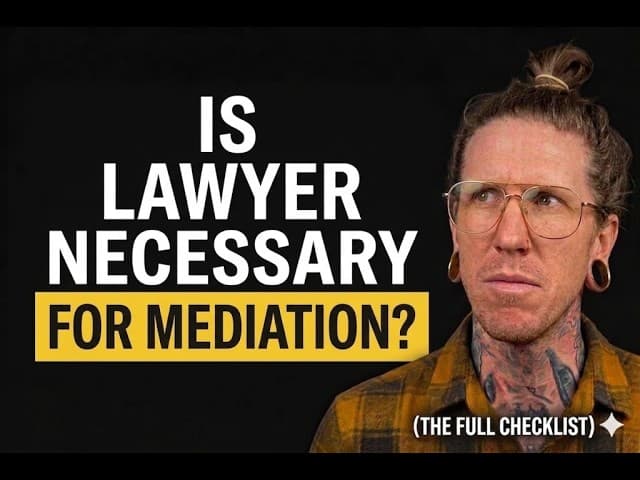
If you are asking whether you can do divorce mediation without a lawyer in Minnesota, the real answer is both simple and nuanced: you can attend mediation without an attorney, but you may still want legal review before you sign or file anything.
In the video below, Ryan McLaughlin of Flannel People Mediation explains the difference between a neutral mediator, a legal advocate, and the kind of outside review that can support a mediation-first divorce.
Source video: Watch the full video on YouTube.
A quick lane marker
This page is for educational purposes only. Flannel provides mediation services, not legal representation or individualized legal advice. A mediator stays neutral and does not act as either person's attorney.
The short version
- You can attend divorce mediation without a lawyer in the session.
- A mediator stays neutral and does not represent either person.
- Legal advice, attorney review, tax advice, or financial advice can still be useful before or after mediation.
- Attorney involvement does not automatically blow up mediation.
- The key is whether both people still want to keep the divorce collaborative and out of court conflict.
Direct answers people are usually looking for
Can we mediate first and still use a lawyer later?
Yes. Many couples use mediation to organize the decisions, then get attorney review before signing or filing anything.
Does “without a lawyer” mean we skip the Minnesota court process?
No. Mediation can help with the decision-making process, but Minnesota courts still handle filings and final orders.
Can a mediator tell me whether the agreement protects me?
No. A mediator can help structure the conversation, but individualized legal advice about your rights or risks belongs to a lawyer.
No, you do not need a lawyer in the mediation room
Many couples mediate without attorneys attending the session. That can work when both people know their lives, understand their finances well enough to participate, and feel able to speak for themselves in the conversation.
This is one reason mediation can feel different from a lawyer-first divorce. The two of you can sit with a neutral mediator and work through parenting, money, property, debts, retirement, support, and practical transition details without immediately turning the process into two opposing legal positions.

But a mediator is not your lawyer
This is the part that matters. A mediator does not represent you. A mediator does not represent your spouse. A mediator does not go to court with you to argue what you meant or protect your individual legal position.
A mediator can structure the conversation, keep the topics organized, help both people reality-test options, and make sure important decisions do not get skipped. But if what you need is individual legal advice, you need a lawyer for that.
That distinction is not a technicality. It is the architecture of mediation. Neutrality is what allows the mediator to hold the conversation for both people instead of advocating for one side.
If what you need is advice about legal rights, court strategy, or whether a proposed agreement is in your individual best interest, that is the point where attorney advice becomes the better tool.
Want to know if mediation fits before hiring lawyers?
A free consultation is the easiest way to talk through your situation, what mediation would cover, and where outside legal review may be useful.
Book a free consultationA practical middle path: mediate first, review before filing
One of the most useful options is not either-or. You can mediate the practical decisions first, then have an attorney, tax advisor, financial advisor, or other trusted professional review the agreement before anything is final.
Ryan uses a simple comparison in the video: you might negotiate a car price yourself, but still have a mechanic inspect the car before you sign. Divorce is obviously bigger than a car. The point is that outside review can happen after the main conversation, before final decisions are locked in.

When a lawyer may be worth bringing in
Legal counsel may be useful when you do not feel comfortable with the material, do not understand the finances, feel unsure advocating for yourself, or sense a power imbalance. It may also be useful when there are complex assets, business interests, unusual debts, disclosure concerns, or questions that need legal analysis.
If one person brings a lawyer and the other feels outmatched, the other person may decide to bring counsel too. That does not automatically end mediation. It does mean the group needs to be clear about the shared goal: keeping the process constructive and, when possible, outside a court fight.

How to decide what fits your divorce
The best question is not, "Are lawyers good or bad?" That is too blunt to be useful. A better question is, "What kind of support do we need at this stage?"
If both people want an amicable path, mediation may be a good first step. If either person needs legal advice before they can participate confidently, that should be respected. And if there are safety concerns, coercion, hidden money, or refusal to disclose information, mediation may not be enough by itself.
For the broader lawyer-intent comparison, read Looking for a Divorce Lawyer in Minnesota? Read This First. For the main service overview, start with divorce mediation in Minnesota.
If you need Minnesota filing information, the court system maintains divorce and dissolution forms and divorce help topics. Those resources are informational and do not replace individualized legal advice.
FAQs about divorce mediation without a lawyer
Can you mediate a divorce without a lawyer in Minnesota?
Yes. You can attend divorce mediation without a lawyer in Minnesota, but mediation is not legal representation and does not replace legal advice.
Should I talk to a lawyer before divorce mediation?
You may want to talk to a lawyer before mediation if you need legal advice, feel unsure about your rights, have complex finances, or are worried about a power imbalance.
Can I have a lawyer review an agreement after mediation?
Yes. Many couples mediate first and then choose attorney, tax, financial, or court-resource review before signing or filing anything.
Does bringing a lawyer end mediation?
No. Bringing in a lawyer does not automatically end mediation. The key question is whether both people still want to keep the process collaborative and outside of a court fight.
Can a mediator tell me if a divorce agreement is fair?
A mediator can help organize the conversation and reality-test options, but a mediator does not represent either person or give legal advice about whether an agreement protects your individual rights.
The next step
If you are trying to keep your divorce practical and calm, you do not have to choose between "no support" and a full lawyer-driven fight. Mediation can be the place where the two of you work through the decisions, with outside review where it makes sense.
Flannel People Mediation is based in Saint Paul, works 100% virtually, and helps Minnesota couples work through divorce in a flat-fee, structured process. You can book a free consultation to talk through whether mediation fits your situation.
Talk through whether mediation-first fits
A free consultation is the easiest way to talk through your situation, what mediation would cover, and where outside legal review may be useful.
Book a free consultationFounder of Flannel People Mediation in Saint Paul, Minnesota. Flannel is rated 4.9/5 from 287+ Google reviews and helps couples work through divorce mediation in a calm, structured, 100% virtual process.