Online & virtual divorce mediation
Online divorce mediation on Zoom, wherever you both live.
You two want to work out the divorce yourselves, without a courtroom fight and without driving across town (or across the country) to sit in an office. I run a structured conversation on Zoom, the two of you make the decisions, and I help you put what you agreed to in writing.
- $1,695 per person, flat. $3,390 for a couple. Not hourly.
- Couples in all 50 states and DC. Including spouses in different states.
- One prepared 3-hour Zoom session, after a private call with each of you.


 4.9 from 292 Google reviews
By the Flannel People Mediation team. Updated October 2026. Flannel People Mediation doesn't practice law or give legal advice; we provide mediation only.
 Ryan · Mediator
“He helped us virtually (though it did feel cosy and connected).”
- $1,695
- per person, flat ($3,390 for a couple)
- 4.9 stars
- from 292 Google reviews
- 50 states + DC
- including spouses in different states
- AI translation
- available; sessions are in English
The basics
What is online divorce mediation?
Online divorce mediation is divorce mediation held on video, usually Zoom. A neutral mediator runs a structured conversation between the two of you about parenting, property, debts, and support, and helps you put what you agree to in writing. The mediator doesn't take sides or decide anything. You two do.
Divorce mediation is a facilitated conversation between two spouses about everything a divorce has to settle: the kids' schedule, the house, retirement accounts, debts, support, and the practical details nobody thinks about until the week they matter. The mediator doesn't take sides and doesn't decide anything. My job is to keep the conversation organized and fair, make sure nothing important gets skipped because it was uncomfortable, and help you write down what the two of you decide.
Online mediation is the same process, run on video. Each of you joins from wherever you are. If one of you has moved out, moved states, or works a schedule that makes a weekday office meeting impossible, it removes the logistics problem without changing what matters: you two stay in control of the outcome.
Is it legit?
Is online divorce mediation legit, and does it work?
Yes. It's the same process as mediating in an office, run on video: a neutral mediator, a structured agenda, and the two of you making every decision. Only the logistics change. Your agreement is written down the same way, and the court side, if you file, works the same way it would after in-person mediation.
It works best when both of you want to settle this yourselves and can speak freely. Video can be easier, not harder: nobody drives across town or across the country, nobody sits in a waiting area with the other person, and each of you speaks from your own space.
Online divorce mediation tends to fit when:
- Both of you want to settle this between yourselves, even if you disagree on a lot right now.
- You live in different cities or states, or one of you travels for work.
- You have kids at home and can't easily line up childcare for an office meeting.
- You'd rather each be in your own space for a hard conversation.
- You want to know the total cost before you start.
It's not the right fit for everyone. See when online mediation isn't a fit.
“I was a ball of nerves before our virtual mediation session. Ryan's calmness, casual approach, insights, observations, and cohesiveness throughout the session helped us get through alot of very difficult topics to the point of an agreement.”
“My ex and I were looking for some help to resolve a stalemate, Ryan was fantastic. Balanced and fair. He helped us virtually (though it did feel cosy and connected) and we were able to come to a resolution and steps forward that will only strengthen our co-parenting.”
“Helped us think through a really tricky multi-state and complex financial situation with compassion and pragmatism! Highly recommended!”
Topics
What can you settle in online mediation?
Everything a divorce has to settle: the parenting schedule, the house, retirement accounts, debts, support, health insurance, and the smaller things that cause fights later, like pets and kids' activities.
Parenting schedule
Weekdays, weekends, holidays, school breaks, exchanges, and how you'll handle changes.
Custody mediationThe house
Who stays, whether it's sold, and how the mortgage gets handled.
Who keeps the houseRetirement accounts
401(k)s, IRAs, and pensions, and how each gets divided.
Dividing retirement accountsDebts
Credit cards, car loans, student loans, and who pays what.
Debt in divorce mediationSupport and kids' expenses
Child support, childcare, activities, and medical costs.
Child support and expensesHealth insurance
Who covers whom, and for how long.
Health insurance after divorceThe pets
Where they live and who pays the vet.
Pets in divorce mediationAlready agreed on most of it?
You can also mediate just one piece, such as a holiday schedule.
Process
How online divorce mediation works, step by step
Five steps: a free 15-minute call, a private call with each of you, a written intake, one prepared 3-hour joint session on Zoom, and, if you reach an agreement, writing it together before the session ends. Most of the preparation happens before the joint session, so the session itself goes to decisions.
How long does online divorce mediation take?
Usually one session. The prepared session is built to cover everything in about 3 hours; a follow-up is available if needed. If yours looks like it will need more than one sitting, I'll tell you plainly before anything else is scheduled, so there's no surprise bill. How long the court side takes afterward depends on your state and county. More on how long divorce mediation takes, or see the full divorce mediation process guide.
- 1Free · 15 minutes
Free 15-minute call
We talk about where things are and whether mediation fits. No commitment.
- 2Private · one each
A private call with each of you
Separately, so each person can say what they can't say with the other listening.
- 3Before the session
Written intake
You gather the facts and numbers before we meet, so the session time goes to decisions instead of hunting for statements.
- 43 hours · Zoom
One prepared 3-hour joint session on Zoom
We work through each topic in order. If a moment needs it, I can talk with each of you separately in a private breakout room and then bring you back together.
- 5In writing
Your agreement in writing
If you reach an agreement, the two of you write it together during the session, in your own words and plain language. Either of you can have an attorney review it, or use it to self-file. It isn't a court filing, and I don't prepare court documents.
Different states
Can we mediate if we live in different states?
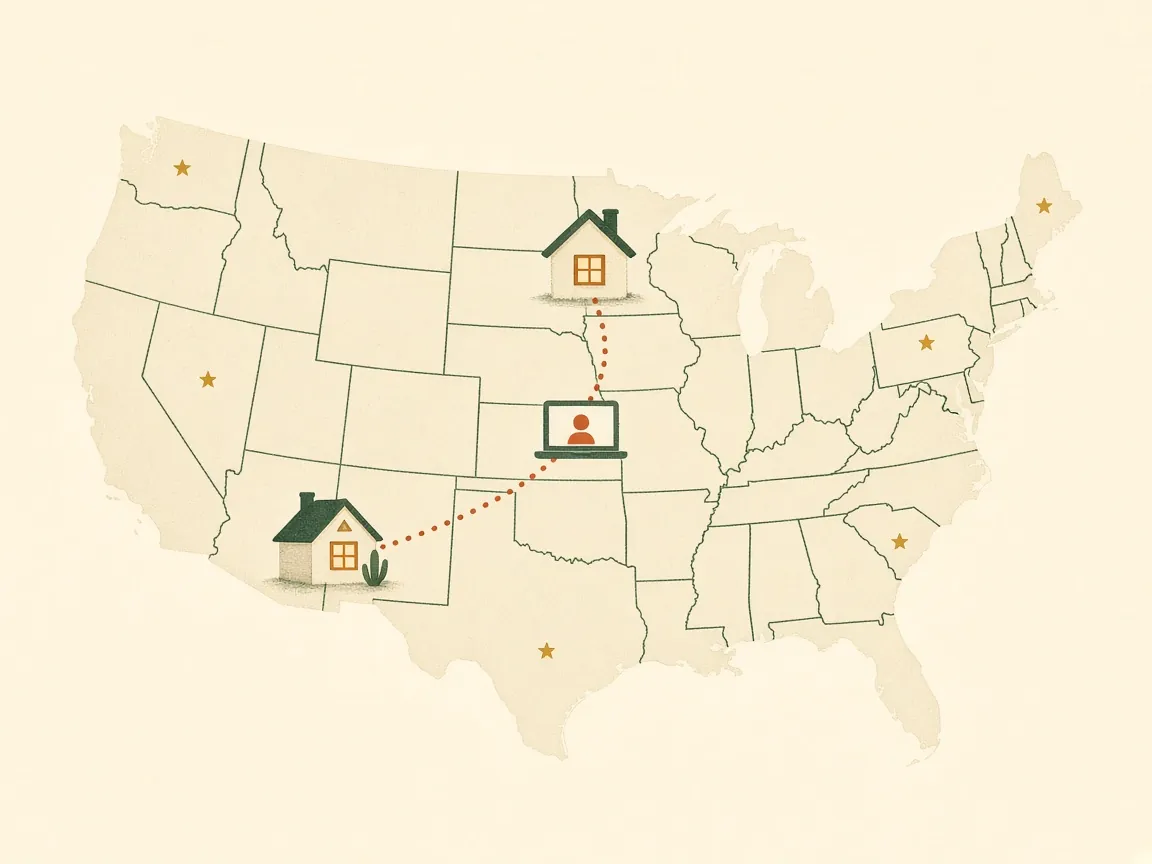
Yes. I work with couples virtually in all 50 states and DC, including spouses who live in different states or have moved since separating. The mediation itself happens on Zoom, so distance doesn't matter. What differs by state is the court side: where you can file, residency rules, forms, and fees.
What if English isn't one spouse's first language?
Mediation sessions are conducted in English. If English isn't one spouse's first language, I offer mediation with AI translation so both of you can follow every part of the conversation. We'll talk through whether that fits on the free call.
Which state's rules apply?
That's decided by where the divorce is filed, which is a court question, not a mediation one. Each state sets its own residency rule. In Minnesota, for example, one spouse must have lived in the state, or been domiciled there, for at least 180 days before the case starts (Minn. Stat. § 518.07). Custody has its own rule: Minnesota's custody-jurisdiction statute generally sends an initial custody case to the child's "home state" (Minn. Stat. § 518D.201).
I don't advise on any state's law or on where to file, and I'm not a state-specific court program. Your state court's self-help pages are the place to check how filing works where you live (Minnesota's is the Judicial Branch divorce page), and either of you can have your own attorney review what you agreed to before anything is filed. If one of you is planning a move, see mediation when one spouse moves out of state.
Practical
What you need for a Zoom mediation session
A laptop or phone with a camera and microphone, a steady internet connection, a private room with a door, and your written intake finished before the session. Headphones help if anyone else is home. Each of you joins on your own device, from your own space, even if you still live in the same house.

A private room with a door
Kids, roommates, and new partners shouldn't be in earshot. Headphones help.
A laptop, if you have one
Not just a phone. Seeing a shared document on a bigger screen makes the numbers easier to follow.
Your intake done before the session
Walking in with the facts already gathered is what lets the session go to decisions.
Separate devices and separate locations
Even if you still live in the same house. Each of you should be able to speak freely.
If the connection drops, we reconnect. Nothing is decided by default. For the documents and numbers to gather, see what to bring to divorce mediation.
Privacy
Is online mediation private and secure?
It's as private as the two rooms you join from. Each of you joins from a room where nobody else can hear, nobody records, and you use a secure connection rather than public Wi-Fi. During the session, private breakout rooms let me talk with each of you separately without the other listening.
This is the same checklist a federal court's mediation program gives its Zoom participants (S.D.N.Y. Zoom Mediation Best Practices Guide). How confidentiality rules apply to your situation is a legal question; your own attorney can answer it.
Privacy checklist
- Nobody else listening.No unannounced observers in the room or off camera. If someone else is in the house, close the door and use headphones.
- No recording.Neither of you records the session, by Zoom or any other app.
- A secure connection.Home Wi-Fi rather than public Wi-Fi at a coffee shop or airport.
- Blur, don't fake, your background.A blurred background still shows if someone walks in; a virtual one can hide them.
Documents
How documents are shared, and how the agreement gets written
Before the session, each of you completes a written intake, and the numbers go into one shared balance sheet of accounts and balances. During the session we look at the same document on screen. If you reach an agreement, the two of you write it together before the session ends, in your own words and plain language.
- Before
Written intake
Each of you completes a written intake, and the numbers go into one shared balance sheet of accounts and balances.
- During
One document on screen
During the session we look at the same document on screen, so you're both working from the same numbers.
- After
The agreement you wrote
If you reached an agreement, you leave with the one you wrote together, in your own words.
That agreement isn't a court filing. I don't prepare court documents or file anything. Either of you can have an attorney review it, or use it to self-file, and your state court's self-help resources explain how filing works where you live.
Cost
How much does online divorce mediation cost?
$1,695 per person, flat, so $3,390 for the two of you. That covers a private call with each of you, a written intake, and one prepared 3-hour Zoom session. It isn't hourly. Court filing fees and any attorney either of you hires are separate.
There's no meter running on prep, calls, or emails. What sits outside the fee: your court's filing fee, any attorney either of you hires to review the agreement, and outside professionals such as appraisers or financial planners. Those are billed by the court or by those professionals, not by me. Minnesota couples can see the county-by-county filing fees on the divorce mediation cost page, or estimate a total with the cost calculator.
Flat fee · online divorce mediation
$1,695per person
$3,390 for the two of you. Not hourly.
- A private call with each of you
- A written intake
- One prepared 3-hour joint session on Zoom
- Time to write your agreement together, if you reach one
Free, 15 minutes, no commitment.
Online vs. in-person mediation
And how both compare with each spouse hiring a lawyer and going to court.
The format changes the logistics, not the principle. In both, a neutral mediator runs the conversation, and the two of you decide whether and how to settle. Online removes travel and makes scheduling easier, especially when you live apart. Private breakout rooms let me talk with each of you separately without anyone sitting in a hallway. Some people simply prefer being in the same physical room, and that's a fine reason to ask about it.
Who runs the conversation
- Online, on Zoom
- A neutral mediator
- In person
- A neutral mediator
Who decides
- Online, on Zoom
- The two of you
- In person
- The two of you
How it's billed
- Online, on Zoom
- $1,695 per person, flat
- In person
- In-person options may be available on request, for an additional fee.
Travel
- Online, on Zoom
- None. Each of you joins from your own space.
- In person
- Both of you travel to the same room.
Private time with the mediator
- Online, on Zoom
- Private breakout rooms
- In person
- A separate room
Sessions are on Zoom. In-person options may be available on request, for an additional fee.
Safety
When online mediation isn't the right fit
If there's been abuse, if one of you is afraid of the other, or if one spouse is hiding information or won't take part in good faith, joint mediation may not be safe or useful. I talk with each of you privately before any joint session, partly to check for exactly this. Either of you can stop at any time.
Minnesota law draws a similar line for court-referred custody mediation: if a court finds probable cause of physical or sexual abuse, it can't require or refer the parties to mediation (Minn. Stat. § 518.619, subd. 2).
If you are in danger, call 911.
The National Domestic Violence Hotline is 1-800-799-7233.
Other services
Other online mediation
The same Zoom format works for other kinds of conflict. This page is about divorce.
FAQ
Online divorce mediation: frequently asked questions
Educational information only, not legal advice. Flannel People Mediation provides mediation services and does not provide legal representation.
What is online divorce mediation?
It's divorce mediation held on video, usually Zoom. A neutral mediator runs a structured conversation between the two spouses about parenting, property, debts, and support, and helps them put what they agree to in writing. The mediator doesn't decide anything or take sides.
Is online divorce mediation legit?
Yes. It's the same process as mediating in an office: a neutral mediator, a structured agenda, and the two of you making the decisions. Only the room changes. What you agree to is written down the same way, and any court steps, such as filing, happen the same way they would after in-person mediation.
Can we do online divorce mediation if we live in different states?
Yes. I work with couples virtually in all 50 states and DC, including couples who live in different states. Filing rules differ by state, so check your state court's self-help resources about where and how to file, and have your own attorney review the agreement if you choose.
Which state's rules apply if we live in different states?
That depends on where the divorce is filed, which is a court question, not a mediation one. In Minnesota, for example, one spouse must have lived in the state for at least 180 days before filing (Minn. Stat. § 518.07). Check your state court's self-help pages or ask your own attorney.
How much does online divorce mediation cost?
$1,695 per person, flat, so $3,390 for a couple. It covers a private call with each of you, a written intake, and one prepared 3-hour joint session on Zoom. Court filing fees and any attorney you hire are separate.
How long does online divorce mediation take?
Usually one session: one prepared 3-hour Zoom session, after a private call with each of you and a written intake. The session is built to cover everything in about 3 hours; a follow-up is available if needed. How long the court side takes after that depends on your state and county.
What do I need for a Zoom mediation?
A laptop or phone with a camera and microphone, a steady internet connection, and a private room with a door. Headphones help if anyone else is home. Each of you joins on your own device from your own space, even if you still live in the same house.
Is online mediation as effective as meeting in person?
The process is the same: a neutral mediator, a structured agenda, and the two of you making the decisions. Online can make it easier to schedule and lets each of you speak from your own space. Some people prefer an in-person room. In-person options may be available on request, for an additional fee.
Is online mediation private?
The session is private when both of you set it up that way: each of you in a room where nobody else can hear, no recording, and a secure internet connection rather than public Wi-Fi. Private breakout rooms let me talk with each of you separately during the session.
Does the mediator give legal advice or file our divorce?
No. I'm a mediator. I don't practice law, give legal advice, or prepare court documents. If you reach an agreement, the two of you write it together during the session, in your own words. Either of you can have an attorney review it, or use it to self-file.
What if my spouse isn't ready to mediate?
You can start with a free 15-minute call on your own. You don't have to agree to anything, and mediation only goes ahead if both of you choose it. Either of you can stop at any time.
What if English isn't my spouse's first language?
Sessions are conducted in English, and I offer mediation with AI translation so both spouses can follow the conversation. We can talk through whether that fits on the free 15-minute call.
What if there has been abuse or one of us feels unsafe?
Joint mediation may not be appropriate. I speak with each person privately before any joint session, and either person can stop at any time. If you are in danger, call 911. The National Domestic Violence Hotline is 1-800-799-7233.
Sources I checked
Primary sources, read at the source in October 2026. Minnesota is used as the example; other states have their own rules.
- 01Minn. Stat. § 518.07 (residence of parties)A Minnesota divorce requires one spouse to have lived in, or been domiciled in, Minnesota for at least 180 days before the case starts (with a narrow exception in subd. 2). Read Oct 30, 2026.
- 02Minn. Stat. § 518D.201 (initial child custody jurisdiction)Minnesota's version of the uniform custody-jurisdiction rule: an initial custody case generally belongs in the child's home state. Read Oct 30, 2026.
- 03Minnesota Judicial Branch: Divorce/DissolutionResidency (180 days), where to file, and the courts' note that a divorce can take several months to become final.
- 04Minn. Stat. § 518.619 (custody or parenting time mediation)When custody disputes may be set for mediation, the abuse exception, privacy of records, and how a mediated agreement reaches the court.
- 05U.S. District Court, S.D.N.Y.: Zoom Mediation Best Practices Guide (July 2021)A federal court mediation program's privacy checklist for Zoom: no unannounced observers, no recording, secure Wi-Fi, headsets, blurred rather than virtual backgrounds. Read Oct 30, 2026.
Keep reading
- What divorce mediation costsThe flat fee, what sits outside it, and Minnesota filing fees by county.
- The divorce mediation process, step by stepEvery stage, from the first call to the written agreement.
- Child custody mediationBuilding a parenting plan the two of you agree on.
- When one spouse moves out of stateRelocation, parenting schedules, travel, and legal review.
- What to bring to divorce mediationThe documents and numbers to gather for your intake.
- When one spouse isn't readyYou can start with a call on your own.

Next step
Start with a free 15-minute call
If you're both willing to try, the next step is a short call to see whether this fits your situation. You'll talk with me, not a call center. Spouse not ready yet? You can start with a call on your own.