

Private space
Who sleeps where. Which rooms or storage are private. Whether you enter each other’s space only with permission.
Under one roof, for now
If you are still sharing a home while you divorce, you can make this season more predictable. Write down a few house rules, decide how you will talk with your kids, and make a holiday plan for this year. You do not have to pretend you are a happy family, and you do not have to finish every long-term decision before the holiday arrives.
Talk with Ryan or Kate · free · 15 min · nothing to sign
Or text us: (763) 316-8323
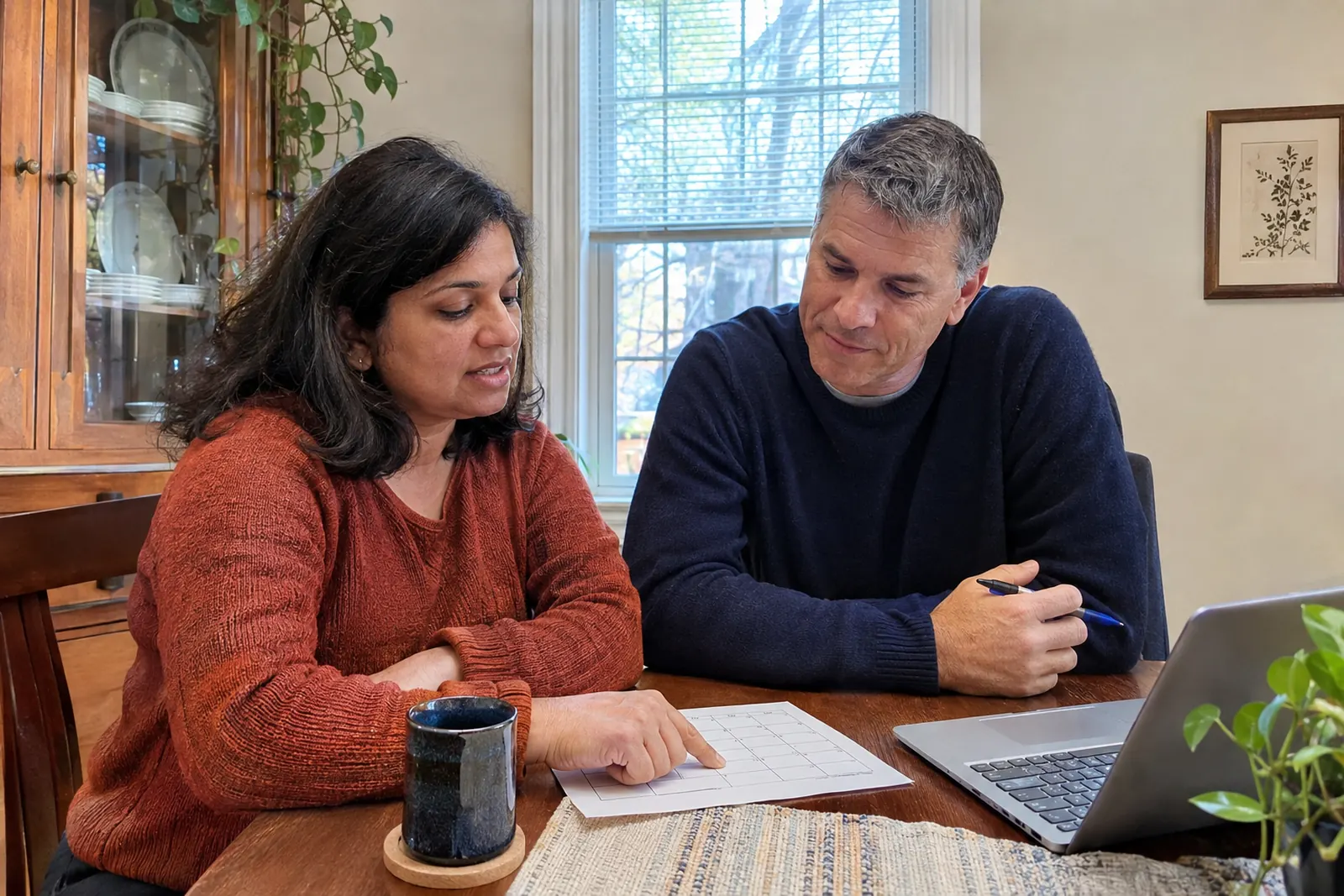
Direct answer. You can live in the same house during a divorce and still give the kids a calmer holiday. Agree on private space, who is “on” with the children and when, and a simple plan for Thanksgiving and the winter break — including whether you will celebrate together, split the day, or mark the holiday on a different date. If you want that plan in writing, mediation can help you work out a temporary agreement and co-write it in your own words during the session.
General information, not legal advice. Ryan facilitates; he doesn’t practice law or give legal advice. For questions about filing, a separation date, or how living under one roof affects a legal timeline, talk with your own lawyer.
Day to day
Sharing a home after you have decided to divorce is hard because the old routines no longer fit, and new ones have not been written down. A short, written list of house rules gives both of you something to point to when a tense moment comes up.
Who sleeps where. Which rooms or storage are private. Whether you enter each other’s space only with permission.
How you will use common rooms, and when the house needs to be quiet for work, sleep, or downtime.
Whether you shop and cook separately, share some meals, or take turns. How shared food and household supplies are handled.
Who pays which recurring bills for now, who handles the kids’ day-to-day things, and how you will flag a problem without a late-night argument.
Even under one roof, name who handles mornings, homework, bedtime, and activities on which days, and when each parent has uninterrupted time with the children.
Whether friends or relatives can come over, how much notice you will give, and whether new partners come to the shared home at all while you still live together.
Keep household logistics practical. Save harder divorce conversations for a set time, or for mediation, and out of the children’s hearing. A shared calendar or a short text thread can carry the daily details.
When you will look at the arrangement again, and what would trigger an earlier conversation — including a plan for when one of you is ready to move.
These rules are a temporary working agreement between the two of you. They are not a court filing. Even an informal written agreement can matter later, so either of you can ask your own lawyer to review it before you sign. If you are thinking about moving out, see Divorce mediation and moving out of the house.
What the kids hear
Kids notice the spare room, the separate calendars, and the change in tone long before anyone makes a speech. A simple, honest explanation — in language that fits their age — is kinder than a performance.
Parents of younger children may also want Divorce mediation for couples with young kids.
This year’s calendar
You do not have to recreate last year’s holiday. You also do not have to cancel it. What helps is a plan the kids can count on, written down before the week arrives.
One parent is “on” in the morning, the other in the afternoon, with a clear handoff time. The off-duty parent can leave the house, or take quiet time in a private room, so the kids are not managing two adults at once.
Each parent marks the holiday with the kids on a different day or at a different time, so no one has to stage a single family meal.
One parent takes the kids to family; the other has the house to themselves. Agree on departure and return times, and on how you will describe the plan to relatives.
Thanksgiving with one parent this year, with the other next year, and a similar split for the winter break. Write both years down so it does not have to be renegotiated in November.
If a new holiday schedule would add stress, stay with the weekday pattern you already have and add one special outing or meal.
Write down the practical details
You do not have to give relatives, or the kids, a false impression of a happy family. A calm, honest plan — “We’ll have dinner with Mom at 2, and time with Dad in the evening” — is clearer than a performance.
If you later write a longer-term Minnesota parenting plan, this year’s holiday plan can inform that document. The temporary plan you write now does not have to settle every future holiday.
A spreadsheet for Excel or Google Sheets, with a 12-month shared calendar, a holiday rotation, and a shared-expense tracker. General information, not legal advice.
Short before-and-after scripts for scheduling, money, and kid logistics. General information, not legal advice.
Before or after the holidays
There is no single right date to start a conversation about divorce, or to file. Some people want a written holiday plan in place before the week arrives, so the kids are not left in limbo. Some people wait until after the holidays to reduce stress on gatherings and on the children. Both are understandable. What matters is that the two of you know what this year’s days will look like, and that legal questions go to a lawyer, not to a guess.
Private mediation is a conversation and a written agreement between the two of you. Filing is a separate court step.
You can write a plan for the house and the holidays even if the longer divorce decisions take more time.
Filing, residency, a separation date, and how living under one roof affects a legal timeline depend on your state. Flannel People Mediation does not practice law or give legal advice.
The other person can still book a free 15-minute call alone. For private mediation, mediation goes ahead only if both of you choose it.
If you are thinking about the first official steps, see What to do before filing for divorce in Minnesota. That page is Minnesota-specific; if you live in another state, ask your own lawyer about local filing rules.
The Flannel Three-Part Process
You do not have to work these questions out at midnight in the hallway. In mediation, you can sit down — each from your own room, on Zoom — and write a temporary agreement covering the house, the kids, and this year’s holidays. The process is hyper-engineered so you are not starting from a blank conversation.
Your mediator hears what matters to each of you before you are in the same session. Neither of you hears the other’s meeting.
You gather the calendars, the bills, and the questions you want to settle for now, without having to resolve everything at once.
You work through the topics you both want to address and co-write the agreement in your own words during the session. It is your agreement in writing, not a court filing. Even an informal written agreement can matter later, so either of you can ask your own lawyer to review it before you sign.
Zoom works in all 50 states plus DC, and a spouse can join from abroad by Zoom. In-person options are in Minnesota: a St. Paul-area conference room or a rented retreat cabin. The fee is a flat fee known up front, set by where you meet.
Session prices are listed on our divorce page. Either of you can book the free 15-minute call on your own. Come alone or together. Nothing to sign.
Your mediator may be Ryan or Kate. Ryan facilitates; he doesn’t practice law or give legal advice. Kate also does not practice law or give legal advice in Flannel People Mediation sessions. Kate McLaughlin is listed on the Minnesota Judicial Branch’s Rule 114 roster for family mediation. Ask us which of us would mediate your sessions. A short free video course, How a Prepared Mediation Works, walks through the process at your own pace.
Safety
Joint mediation may not be the right fit if there has been abuse, if one of you is afraid of the other, or if someone feels unsafe in the home.
The National Domestic Violence Hotline is 1-800-799-7233. You can also text START to 88788.
We do not give advice about staying in or leaving an unsafe home. This page does not cover those situations.
Questions people are asking
There is no single pattern that fits every family. Couples who are still under the same roof often split the day, hold two smaller celebrations, or have one parent take the kids to relatives while the other has the house. What helps is writing down start and end times, what you will tell the kids and relatives, and who is “on” at each point, so no one is improvising on the day. Mediation can help you turn that into a temporary agreement in your own words.
You do not have to stage a traditional family holiday if that would confuse the kids or wear you both out. You can tell the children, in age-appropriate language, what the day will actually look like, and you can celebrate in two shorter stretches or on a different date. A calm, honest plan is clearer than a performance. Agree on one sentence you will both use with relatives so you are not explaining it in the doorway.
It is stressful, even when both of you are trying. The days go more smoothly when private space, shared spaces, meals, bills, guests, and who is “on” with the kids are written down, and when harder divorce conversations happen at a set time or in mediation, not in front of the children. Give the arrangement a review date. If someone is getting ready to move, a temporary move-out plan is a separate conversation worth having in writing too.
There is no universally right date to file or to start the conversation. Some people want a holiday plan in writing before the week begins. Some people wait until after the holidays. You can mediate, and write a temporary agreement for this season, before anyone files. Questions about filing, a separation date, or how living under one roof affects a legal timeline belong with your own lawyer.
Yes. The agreement can cover house rules, a holiday plan, how you will talk with the kids, and related money or scheduling questions for now. You co-write it in your own words during the session. It is your agreement in writing, not a court filing. Even an informal written agreement can matter later, so either of you can ask your own lawyer to review it before you sign. Your own lawyer or, in Minnesota, the court’s Self-Help Center can explain the court process, if you later want that.
No. Flannel People Mediation works with couples by Zoom in all 50 states plus DC, and a spouse can join from abroad by Zoom. For legal questions in your state, talk with a lawyer licensed there.
Free 15-minute call
Talk with Ryan or Kate about a temporary plan for the house, the kids, and this year’s holidays. Come alone or together. Nothing to sign.
Reply within the hour(during normal business hours)Zoom works in all 50 states plus DC, and a spouse can join from abroad by Zoom. We help two people who don't agree on really tricky issues come to an agreement and put that agreement in writing. We don't draft court documents, we don't file, we don't do anything with the courts, and we don't give legal advice. Or text us: (763) 316-8323.
Educational Disclaimer: The information provided on this website is for educational purposes only and is not intended as legal advice, therapeutic advice, or therapy. Flannel People Mediation is a mediation service provider only. We help two people who don't agree on really tricky issues come to an agreement and put that agreement in writing. We don't draft court documents, we don't file, we don't do anything with the courts, and we don't give legal advice. We do not provide therapeutic services. For legal questions, talk to your own attorney or the court's Self-Help Center.
Flannel People Mediation provides mediation services only. Ryan McLaughlin does not provide legal, insurance, valuation, tax, financial, or business advice, and mediation does not replace your own counsel or advisors.
Follow our work in Google
Tell Google you want to see more of our writing on divorce and mediation. It takes one tick of a box, and it changes your results, not ours.
Make us a preferred source