The Spousal Support System™ · Professional License
Your clients are stuck on one number.Work it out with them, on one screen.
Minnesota weighs eight factors for spousal maintenance and names no amount. This is the worksheet I built for that gap: both proposals written down first, five states’ published formulas with the math shown, and both households tested at the same figure. You run it with your clients. I host it and keep it current.
Or $250 a month. Paying yearly saves $500 (17%). Founding price for the first 10 licenses; $3,500 after that.
By purchasing, you agree to the license terms.
What practitioners ask me first:
- Can my clients use it on their own?
- What's in the license?
- Does it work outside Minnesota?
- Something else?
Tap one for the answer.
Founding annual license
Save 17%
$2,500/ year
Why it stalls
$2,600 a month, says one.$1,200, says the other.
Both of them think they’re being reasonable. In Minnesota nobody can tell either one they’re wrong, because the statute lists eight factors and never names an amount. So the case stalls on the one number that has no formula, and it stalls in your office.
The worksheet doesn’t produce the answer. It puts the disagreement on a screen where both people can see what’s driving it, and that’s a disagreement you can work with.
Minn. Stat. § 518.552, subd. 2 and 3 (2024)
What you run with your clients
Four steps, in the order that keeps anyone from anchoring.
- 1
Both numbers, in writing, first.
Incomes, expenses after the divorce, and each spouse's monthly proposal, before a single formula appears. A number written down before the reference points show up can't be quietly moved to meet them.
Northcraft & Neale (1987), OBHDP 39(1)
- 2
What five states would calculate.
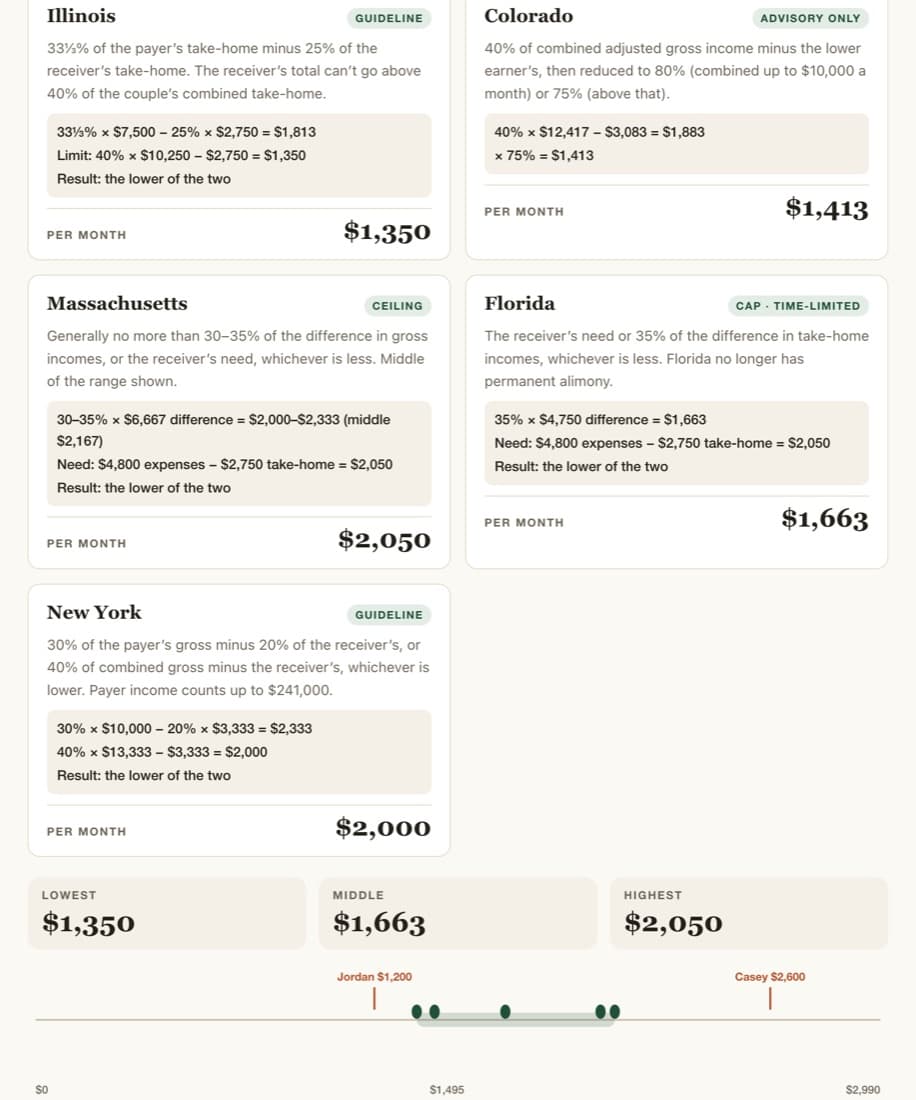
Illinois, Colorado, New York, Massachusetts and Florida each wrote a formula. The worksheet shows each one, the couple's numbers inside it, and a monthly result. Reference points, never a forecast of Minnesota.
Formulas checked against each statute, August 31, 2026
- 3
The neutral's read.
Each spouse writes what a neutral stranger would say about their own number, then writes the number again. In the study this step comes from, it took the rate of failed settlements from 35% to 4%.
Babcock, Loewenstein & Issacharoff (1997), Law & Social Inquiry 22
- 4
Test one figure against both households.
Pick a monthly figure and both take-homes sit next to both budgets. You say what it shows (“at this number, this household is short $400 a month”) and they decide what it means.
Open the sample to see all four with a made-up couple, Jordan and Casey.
Watch it run
Four minutes, one made-up couple.
Jordan proposes $100 a month. Casey proposes $2,800. Here’s where five states land, what the neutral’s read does to both numbers, and what one figure does to two households.
Recorded live at a practitioner workshop, September 17, 2026.
The math on the license
One case pays for the year.
The annual license is $2,500. If the worksheet keeps one support conversation from stalling into another round of letters, or brings in one client who wanted a structured way through the number, it has paid for itself. Put in your own fee and see.
One case covers the year, with $890 left over.
Everything in one license
The guide used to be $500 by itself.
Now it comes inside the license, with the worksheet it was written for, and the worksheet isn’t sold any other way.
| In the license | On its own |
|---|---|
The practitioner guide The whole protocol, stage by stage, scripts written out | $500 its price on its own until today |
The worksheet, both views Shared-screen three steps, plus the full mediator view | Not sold alone |
Statute re-checks and updates Five states' formulas re-verified; fixes and new views | Included |
Your own key One personal link, good for as long as your license is | Included |
Email support Something looks wrong, you email, I fix it | Included |
The pre-session email The one-number prep that makes step one work | Included |
Unlimited client use No per-case fee, no client count | Included |
The license Founding price, first 10 licenses · $3,500 after that | $2,500 a year, or $250 a month |
Pick how you pay
Same license either way. Yearly costs less.
Founding price lock. The first 10 licenses keep $2,500 a year, or $250 a month, for as long as they renew without a gap. After that the license is $3,500 a year, or $350 a month.
Save $500 · 17% off
Annual
$2,500/ year
$3,000 if you paid monthly · works out to about $208 a month
Both include the worksheet, the guide, updates, and unlimited use with your own clients. One practitioner per license.
By purchasing, you agree to the license terms.
After you pay, your personal links come by email the same business day.
Who it’s for
Mediators
Something concrete on the screen when support becomes the sticking point.
Family law attorneys
A structured way to walk a client through the number before the next negotiation.
Divorce financial professionals
The two-household arithmetic, laid out, while the legal questions stay with the lawyers.
Divorce coaches
A way to help a client get clear on their own number without telling them what it should be.
The email you send first
Step one starts before anyone logs on.
Copy it. It’s the only prep the worksheet needs from your clients.
Subject: Before we talk about support
Before we meet, each of you write down one number: the monthly support you’d propose right now.
Don’t share it with each other, and don’t look anything up first. Just bring it.
Both numbers go on the screen before anything else does.
What it deliberately doesn’t do
- Predict what a Minnesota judge would order.
- Recommend a number to anyone.
- Give legal advice, to you or to your clients.
- Draft clause language or court forms.
- Go home with your clients to be run alone.
Why you don’t get the code
Because you’d have to keep it working. I host it, re-check each state’s formula against its statute, and fix it when something changes. You open your link and run the conversation. The software, the method and the name stay with Flannel People Mediation, and the license is non-exclusive.
Questions
- Can my clients use it on their own?
- No, and that's on purpose. Alone at the kitchen table, five states' dollar figures read like an entitlement. With you running it, they read as what they are: reference points. The license covers using it with your clients, in your sessions or on a screen share.
- Can I put it on my website?
- No. There's no embed and no client login. You open it from your own link and run it with the people in front of you.
- Do I get the code?
- No. I host it, keep the formulas checked against each statute, and fix it when something breaks. You don't need a developer, and you don't need to maintain anything.
- Does it tell my clients what they're entitled to?
- No. It doesn't predict what a Minnesota court would order, it doesn't recommend a number, and it isn't legal advice to you or to anyone you use it with. It shows how five other legislatures answer the question, and what one figure does to two households.
- Does it work outside Minnesota?
- The five-state formulas and the household test work anywhere. The duration presumption at the end is Minnesota's, Minn. Stat. § 518.552, so outside Minnesota you'd set that part aside.
- What happens if I stop paying?
- Your link stops working at the end of the month or year you paid for. Monthly licenses cancel anytime.
- Can more than one person in my practice use it?
- Each license is for one practitioner. Text or email me if you want it for a whole practice and we'll work out the number.
$2,500 a year. Every support case you run.
Or $250 a month, while the first 10 licenses last. After that, $3,500 a year. Built by Ryan McLaughlin, Flannel People Mediation, Saint Paul.
By purchasing, you agree to the license terms.
A psychological tool, not a legal one
The Spousal Support System™ is used for psychological anchoring purposes only. Its figures are reference points taken from other states’ published formulas, shown so people can see and work with the anchors in a negotiation. They are not what a Minnesota court would order, and not what any court, judge, or judicial officer anywhere would order. The System does not predict an outcome, recommend an amount, or evaluate anyone’s legal position.
It is not legal advice, financial advice, or tax advice, to the practitioner or to anyone the practitioner uses it with, and using it creates no attorney-client relationship. Anyone deciding on spousal support should have their own attorney review any agreement before signing it.
Refunds: you may request a refund within 14 days of a payment. After 14 days, no refunds are given. Each renewal is billed by invoice, and you can cancel anytime. Full terms: license terms.